


Morocco’s Marrakesh Dyeing Houses and Leather Workshops: A Sensory Classroom on Color and Smell
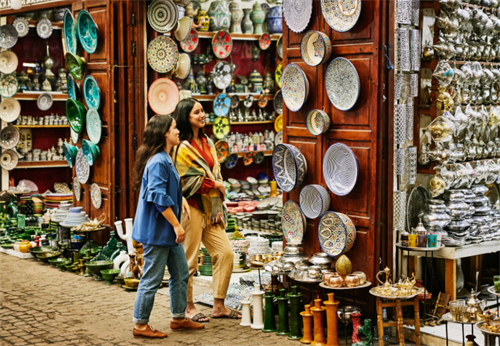
Most family travel guides talk about what children see. Marrakesh is different. It teaches through what children smell, hear, touch, and slowly make sense of.
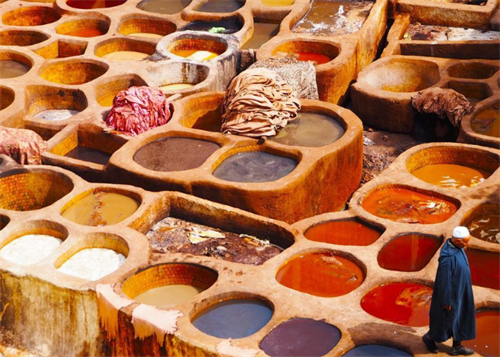
In the northern medina of Marrakesh, near Bab Debbagh, dyeing houses and leather tanneries operate much as they have since the 11th century. These are not curated museums or staged demonstrations. They are gritty, working environments where animal hides arrive on donkey carts, are softened in stone vats, dyed with saffron and indigo, and transformed into leather that still carries the imprint of human labor.
For families, this creates a rare opportunity: to let children encounter how things are actually made, not as a product, but as a process involving time, discomfort, skill, and tradition.
Why Marrakesh’s Artisan Quarters Matter in the Moroccan Context?
Morocco’s handicrafts form a national cultural backbone rather than a niche tourism feature. Leatherwork, in particular, is so deeply rooted that the French word maroquinerie derives directly from Morocco’s historical leather trade. Across the country, families encounter variations of this tradition—from the monumental Chouara tanneries of Fez to small street workshops in Essaouira and the Atlas foothills.
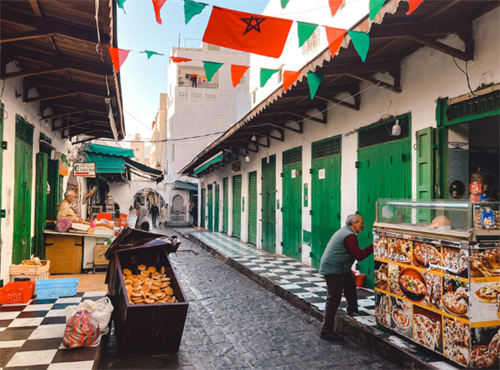
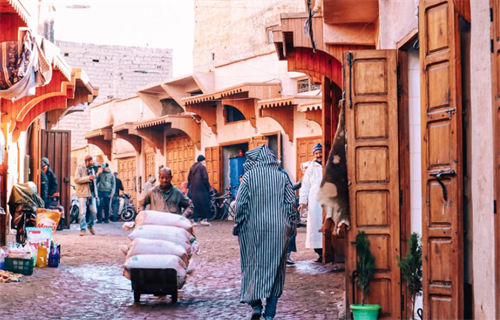
What distinguishes Marrakesh is proximity. The city’s tanneries and dyeing houses are embedded in residential neighborhoods rather than isolated viewing complexes. Children walk past butcher stalls, donkey carts carrying fresh hides, and small workshops where artisans work within arm’s reach of daily life. This spatial integration reflects how Moroccan medinas functioned historically—as economic, social, and domestic systems combined (Wikipedia contributors, n.d.).
Planning a Family Visit: Timing, Climate, and Expectations
Timing is the most important variable when visiting Marrakesh’s tanneries with children. Early mornings—typically between 8:30 and 10:30—offer the best balance of activity and tolerable sensory conditions. By midday, heat intensifies odors and fatigue, especially in warmer months.
March consistently emerges as one of the most family-friendly periods to visit Morocco. Moderate temperatures make walking manageable, and artisanal production remains active without the oppressive heat of summer. Families traveling during cooler months often find children more receptive and observant rather than overwhelmed.
Equally important is duration. Thirty minutes inside the tannery area is sufficient for most children. The educational value lies in exposure and explanation, not prolonged endurance.
Inside the Dyeing Houses: Color as Process, Not Decoration
The dyeing houses near Bab Debbagh reveal color as something unstable and responsive, not fixed. Natural pigments—derived from saffron, indigo, poppy, and mineral sources—are mixed by experience rather than formula. Children quickly notice that color deepens unevenly, that sunlight alters hue, and that fabric behaves differently depending on fiber type.
This environment lends itself naturally to experiential learning. Observing dyed wool drying overhead illustrates basic chemical and physical principles: absorption, oxidation, and evaporation. According to traditional craft documentation, these techniques have remained largely unchanged for centuries precisely because they rely on local materials and embodied knowledge rather than industrial standardization.
Encouraging children to sketch, photograph details, or compare wet and dry fabrics transforms passive looking into active inquiry.
Leather Tanneries: Transformation, Labor, and Honest Conversation
The tanneries are the most challenging—and most educational—part of the visit. Leather production begins with soaking hides in water and lime, followed by treatment in organic mixtures that historically included animal waste to break down remaining tissue. While modern hygiene standards have improved, the process still produces the distinctive smell for which Moroccan tanneries are known.
Rather than avoiding explanation, families benefit from age-appropriate honesty. Children often cope better when they understand why something smells unpleasant. Mint sprigs, traditionally offered to visitors, reduce discomfort but also signal the difficulty of the work.
Historically, tanneries were located on the outskirts of cities due to both odor and health concerns—a pattern visible across medieval Islamic urban planning (UNESCO World Heritage Centre, 1985). Observing artisans standing barefoot in vats under the sun provides a powerful, concrete lesson about labor, resilience, and the human cost behind everyday objects.
Preparing Children Before the Visit: Turning Sensory Shock Into Curiosity
One of the clearest differences between families who find Marrakesh’s tanneries “too much” and those who find them unforgettable lies in pre-visit preparation. Children who walk into the dyeing houses and leather workshops without context often react emotionally to the smell or unfamiliar sights. Children who arrive with even a basic mental framework tend to respond with curiosity instead of discomfort.
A few days before the visit, parents can introduce the idea of process rather than place. Explaining that leather does not begin as a bag or shoe—but as an animal hide that must be cleaned, softened, dyed, and dried—helps children understand that what they will encounter is part of transformation, not chaos. According to cultural heritage education research cited by UNESCO, contextual preparation significantly improves children’s engagement with living heritage environments (UNESCO World Heritage Centre, 1985).
Some families find it helpful to use analogies children already understand. Comparing tanning smells to strong farm environments, composting, or even certain cheeses reframes odor as a byproduct of natural processes rather than something “wrong.” This framing aligns with how traditional Moroccan artisans themselves describe their work—as necessary, practical, and inherited, rather than romantic or sanitized .
Another effective strategy is assigning children a simple observational “mission” before entering:
Notice how many colors you can identify, or watch how people move differently when they are working. Giving children a task anchors their attention and reduces sensory overload.
Guides, Scams, and Cultural Navigation With Children
This is where many family visits go wrong—not because of danger, but because of misaligned expectations.There is no official ticket office at Marrakesh’s tanneries. Visitors are often approached by locals offering guidance. This is not inherently negative, but clarity is essential. Agree on a price before entering. For families, 20–50 dirhams per adult is reasonable. Higher amounts should include extended explanation, not just escorting.
Be aware that many tannery visits end in leather shops. This is normal, but parents should treat it as educational rather than transactional. One of the most valuable lessons children can learn here is not buying impulsively. Smell the leather. Walk away. Explain why time matters in assessing quality.
Families who approach this with calm awareness often report that what could have felt like a “scam” instead becomes a lesson in cultural negotiation.
Safety and Movement in the Medina:
The medina near Bab Debbagh is narrow, busy, and very much lived-in. The most practical safety rule—especially with children—is simple: walk to the right, single file. Motorbikes move fast, and locals expect predictable pedestrian behavior.
Closed shoes are essential. Open sandals are impractical around wet stone, animal hides, and uneven ground. Small backpacks should be worn front-facing in crowded areas, not because of crime, but to avoid snagging against drying skins or carts.
Connecting the Experience to the Rest of Morocco:
One of the most overlooked benefits of visiting Marrakesh’s craft quarters early in a trip is how it enhances later experiences. Families who later visit Fez often recognize similarities and differences between the two cities’ tanneries, while desert routes toward Erg Chebbi reveal how leather goods historically traveled alongside spices and textiles.
Children begin to understand Morocco not as a collection of isolated attractions, but as an interconnected cultural system shaped by geography, trade, and craft continuity.
Marrakesh’s dyeing houses and leather tanneries are not comfortable, sanitized attractions—and that is precisely their value. They confront families with the reality that culture is maintained through work, repetition, and endurance.
For children, the lesson is subtle but lasting: beautiful objects often emerge from difficult processes, and understanding comes not from avoidance, but from thoughtful engagement. Families who prepare, set expectations, and approach the experience with curiosity consistently report that it becomes one of the most memorable parts of their Moroccan journey .
References:
[1]UNESCO World Heritage Centre. (1985). Medina of Marrakesh. https://whc.unesco.org/en/list/331
[2]Wikipedia contributors. (n.d.). Marrakesh. In Wikipedia, The Free Encyclopedia. https://en.wikipedia.org/wiki/Marrakesh
Recommended for you: