


New Zealand Māori Culture & Nature Tour: A Family Journey Through Rotorua’s Geysers, Living Villages, and Geothermal Landscapes
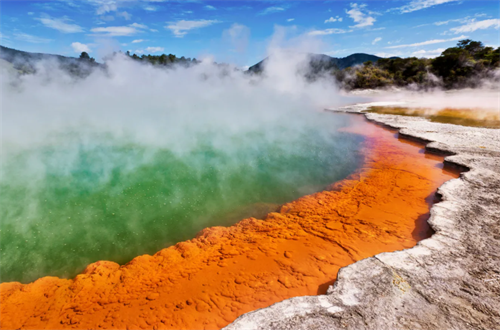
Rotorua is one of those rare destinations where families don’t need to manufacture learning moments—the environment does it for you. Before children understand Māori history, they smell it in the sulfur-rich air. Before they learn about tectonic plates, they feel heat rising through footpaths and see steam curling out of lakefront grass. Rotorua is not subtle, and that is exactly why it works so well for family travel.
Unlike destinations that separate “culture,” “nature,” and “attractions” into neat compartments, Rotorua insists that they be understood together. The geothermal landscape explains Māori settlement patterns. Māori customs explain how the land has been used without being exhausted. For families, this creates an unusually coherent learning journey—one where children can connect science, history, and ethics without realizing they’re doing so.
Why Rotorua Feels So Alive: Geothermal Reality Meets Māori Worldview?
Rotorua sits directly on the Taupō Volcanic Zone, part of the Pacific Ring of Fire. This is not background trivia—it is the reason Rotorua feels different from the moment you arrive. Steam vents appear in public parks. Mud bubbles near playgrounds. Even storm drains exhale warm vapor on cold mornings.
For Māori communities, these geothermal features are not hazards or novelties; they are known entities with names, uses, and stories. Māori identify as kaitiaki, guardians of these geothermal resources, a concept that becomes tangible when families see how hot springs are used for cooking, bathing, and heating—without draining or privatizing them.
This worldview matters for families because it reframes tourism itself. Children quickly understand why fences, boardwalks, and rules exist—not as limitations, but as respect for a living system. Rotorua becomes a place where sustainability is not abstract, but visible underfoot.
Easing In: Government Gardens, Lake Rotorua, and Sensory Orientation
For families arriving after long-haul travel, Rotorua rewards restraint. The Government Gardens and Lake Rotorua lakefront provide the ideal first afternoon: open space, visual calm, and gentle exposure to geothermal features.
The historic Bath House—once a colonial-era spa built around mineral waters—offers a simple narrative contrast between Māori geothermal use and European spa culture. Nearby, Rachel Pool demonstrates geothermal extremes: boiling water contained behind stone walls. For children, this is often the first moment when curiosity meets caution, setting the tone for later park visits.
This unstructured time matters. Rotorua’s sensory intensity—heat, smell, steam—can overwhelm younger children if introduced too aggressively. A slow first day helps families build tolerance and context.
Te Puia: Why Structure Actually Helps Families
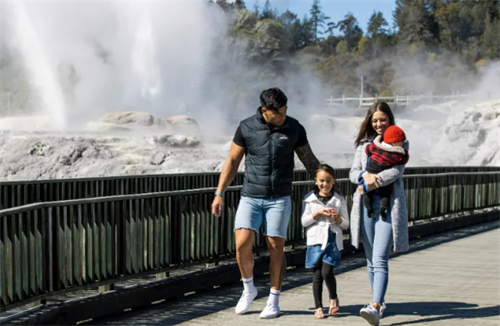
While independent travelers sometimes resist guided attractions, Te Puia is uniquely well-suited to families precisely because of its structure. It removes guesswork and concentrates Rotorua’s key themes into one coherent experience.
The geothermal valley centers around Pōhutu Geyser, the most active geyser in the Southern Hemisphere, erupting up to 20 times daily and reaching heights of around 30 meters. The predictability is family-friendly: children don’t have to wait hours for a payoff, and guides explain why eruptions occur without oversimplifying.
Equally valuable is the New Zealand Māori Arts and Crafts Institute, where children see wood carving and weaving as living skills rather than museum artifacts. Watching apprentices work reinforces the idea that culture evolves through practice.
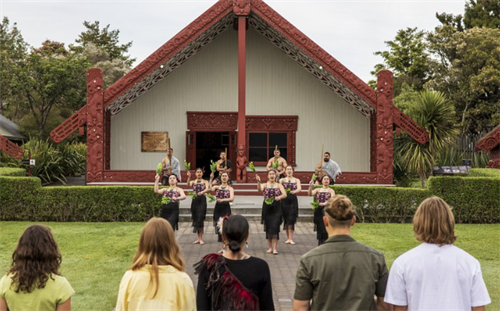
The evening Māori welcome ceremony and kapa haka performance provides emotional resonance. Seen within a wharenui rather than a stage, haka regains its cultural gravity. Children tend to remember the rhythmic footwork and facial expressions, while parents appreciate the layered storytelling behind them.
The traditional hangi meal, cooked using geothermal steam, serves both cultural and practical purposes. After a long day, families benefit from a shared meal that requires no further logistics. While the experience is costly, it consolidates transportation, education, dining, and entertainment into a single decision—often a worthwhile trade-off for parents.
Whakarewarewa Living Village: Daily Life as Cultural Education
If Te Puia provides an overview, Whakarewarewa Living Village provides depth. This is where families encounter Māori culture not as presentation, but as routine.
Guides are residents—often raising children of their own in the village—and this changes the tone immediately. Families see geothermal steam used to cook corn, communal bathing pools still in use, and modern houses coexisting with ancient practices.
Children respond strongly to these everyday details. Watching corn boil in a thermal pool or food steam beneath wooden lids answers questions no textbook can. Parents often note that this visit sparks longer conversations about how societies adapt to their environments rather than reshape them entirely.
The village’s proximity to Pōhutu Geyser also provides a useful visual reminder: the same geothermal force can be spectacle, resource, and responsibility—depending on perspective.
Choosing Geothermal Parks Wisely: Matching Crowds, Energy, and Curiosity
Rotorua’s geothermal parks differ significantly, and families benefit from choosing based on experience style, not reputation alone.
Wai-O-Tapu Thermal Wonderland is visually striking, particularly the Champagne Pool, but it is also the busiest. The daily Lady Knox Geyser eruption—triggered artificially—draws large crowds mid-morning. Families with younger children may find this overwhelming, and timing becomes critical.
By contrast, Waimangu Volcanic Valley offers a more spacious, contemplative experience. Formed after the 1886 Mount Tarawera eruption, it presents geothermal features along a gentle downhill walk. The variety—steaming lakes, silica terraces, crater walls—keeps older children engaged without sensory overload. Shuttle and boat options reduce fatigue, a major plus for families.
Free sites like Kuirau Park and Sulphur Point complement paid attractions. They allow children to observe geothermal activity without ticket pressure and reinforce lessons learned elsewhere.
Hot Springs and Families: Comfort Over Novelty
Soaking in geothermal water is central to Rotorua, but not all hot springs are equally suitable for families.
The Polynesian Spa remains the most practical choice. Its location, safety standards, and clearly defined family pools make it reliable, if not luxurious. Evening visits work particularly well, helping children unwind after active days.
More rustic options like Waikite Valley Hot Pools offer a quieter, more natural setting and are often appreciated by families with older children. While free hot streams such as Kerosene Creek attract budget travelers, safety, hygiene, and access issues make them less ideal for family use.
In Rotorua, convenience and safety often outweigh novelty—especially when traveling with children.
Adventure Activities: Knowing When to Say “Not This Time”
Rotorua is famous for adventure tourism, including white-water rafting on the Kaituna River and its 7-meter Tutea Falls. While thrilling, these experiences are best suited to families with older teens who meet age, height, and confidence requirements.
For many families, watching or discussing these activities offers enough engagement without the added risk. Rotorua does not demand constant adrenaline to feel exciting; its geothermal landscape provides drama at ground level.
Practical Planning for Families: Time, Transport, and Balance
Most families find that two nights and two full days in Rotorua is ideal. This allows time for both cultural immersion and unstructured rest.
A rental car offers flexibility, particularly for geothermal parks outside town, but Rotorua’s compact layout makes central accommodations convenient. The local i-Site visitor center is especially helpful for families, assisting with real-time adjustments based on weather, energy levels, and crowd conditions.
Perhaps the most important planning principle is pacing. Rotorua rewards curiosity, but it also demands respect for physical limits—especially with younger children. Alternating structured visits with open-air downtime keeps the experience enriching rather than exhausting.
Rotorua does something rare in family travel: it teaches without preaching. Children leave understanding that land can be alive, that culture is something people do—not something they display—and that respect for nature is learned through daily practice.For parents, Rotorua offers reassurance that meaningful travel does not require constant motion or spectacle. Sometimes, the most powerful lessons come from watching steam rise from the earth and listening to the people who have lived with it for centuries.
References:
[1]Atkinson, I. A. E., & Taylor, A. H. (1992). Vegetation and climate relationships of geothermal areas in the Taupō Volcanic Zone, New Zealand. Journal of the Royal Society of New Zealand, 22(3), 201–224.https://doi.org/10.1080/03036758.1992.10420826
[2]Geological Society of New Zealand. (2021). The Taupō Volcanic Zone: Active geothermal systems and surface manifestations.https://www.gsnz.org.nz/resources/taupo-volcanic-zone
[3]Ministry for Culture and Heritage. (2023). Māori culture: Kaitiakitanga and relationships with land and natural resources. New Zealand Government.https://mch.govt.nz/maori-culture/kaitiakitanga
[4]Te Puia – New Zealand Māori Arts and Crafts Institute. (2024). Pōhutu Geyser, Te Whakarewarewa geothermal valley, and Māori cultural experiences.https://www.tepuia.com/about/geothermal-valley
[5]Tourism Rotorua. (2024). Rotorua geothermal parks, living Māori villages, and family travel planning.https://www.rotoruanz.com/things-to-do/geothermal
[6]Waimangu Volcanic Valley. (2023). Geological history of the 1886 Mount Tarawera eruption and valley formation.https://www.waimangu.co.nz/about/geology-history
Recommended for you: