


Exploring the Underground Cities of Turkey’s Cappadocia:A Geographical Lesson on Cave Living and Fairy Chimneys for Children
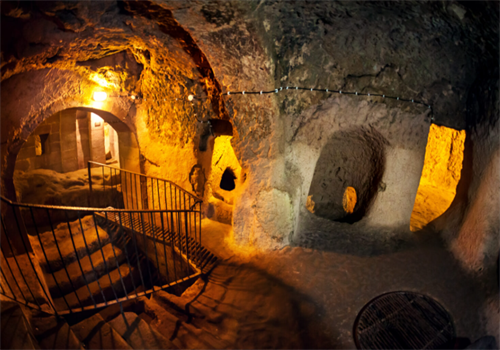
There is a moment in Cappadocia that lingers long after the dust of the valleys has settled on your shoes. It usually happens underground. The air grows cooler, footsteps echo softly, and children instinctively lower their voices—not because they were told to, but because the space itself demands reverence. Standing in a city carved entirely from rock, you realize you are inside a secret world that once sheltered thousands of people from invaders. For kids, this is not a museum—it is an adventure.
Cappadocia, in central Turkey, is often sold through images of hot air balloons floating over honey-colored valleys and cone-shaped fairy chimneys glowing at sunrise. While these images are mesmerizing, the region’s true educational value lies in how naturally it teaches geography, geology, and human ingenuity. Children don’t just learn about volcanic rock, erosion, or early civilizations—they walk through them, touch them, and breathe within them.
The Landscape That Made Underground Cities Possible:
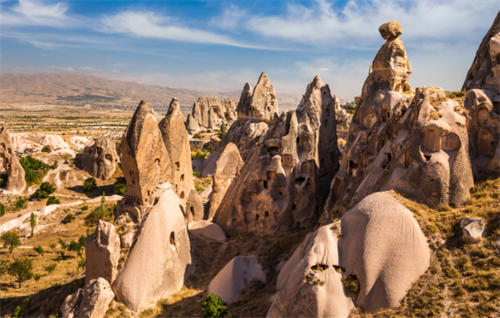
Millions of years ago, eruptions from Mount Erciyes and surrounding volcanoes blanketed Cappadocia in thick ash. Over time, this ash compacted into tuff, a soft volcanic rock. Tuff is easy to carve yet sturdy enough to support elaborate constructions. Wind, rain, and temperature fluctuations gradually sculpted the tuff into the extraordinary cone-shaped formations known as fairy chimneys, their harder caps protecting the softer underlying rock.
This unique geology set the stage for human ingenuity. Early inhabitants didn’t need to invent building materials—the landscape provided them. Above ground, chimneys became homes, churches, and storage spaces. Below ground, the same rock allowed entire cities to be carved, equipped with ventilation shafts, hidden exits, and living quarters. Children can feel the flakiness of the tuff under their fingers, understanding intuitively why people could carve complex underground cities in Cappadocia—but hardly anywhere else.
Underground Cities: Marvels of Engineering
Cappadocia is honeycombed with approximately 35 known underground cities, with more discovered over time. The largest and most famous are Derinkuyu and Kaymaklı, each offering distinct experiences. These cities were originally designed as emergency refuges against invading forces, from Romans to early Arab armies, and later provided sanctuary for persecuted early Christians.
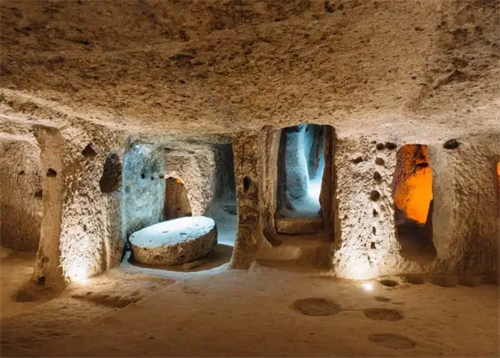
Derinkuyu, the deepest city, reaches 85 meters below ground and could accommodate up to 20,000 people plus livestock. Its 18 levels include living quarters, kitchens, churches, wineries, stables, and deep wells. Ventilation shafts provide fresh air, while massive circular stone doors could isolate sections of the city in case of attack. Narrow passageways forced intruders to move single-file, while hidden escape routes allowed residents to flee if discovered. Remarkably, inhabitants even scheduled cooking at night to conceal smoke from enemies, demonstrating sophisticated planning and discipline.
By contrast, Kaymaklı is wider but shallower, with eight floors (four open to the public). It features stables on the first floor, living quarters and a church on the second, and kitchens, wine presses, and storage areas on the third. Some historians believe Kaymaklı connects to Derinkuyu via tunnels, creating a sprawling subterranean network. These underground cities reveal how humans respond ingeniously to environmental and political pressures, turning geography into a defensive strategy.
Children are naturally drawn to these tunnels. They can explore stone ladders, ventilation shafts, and hidden doors while imagining the lives of those who carved them centuries ago. When one ten-year-old visitor counted footsteps between air shafts in Derinkuyu, it became an unplanned yet memorable geography lesson.
History and Cultural Significance:
Cappadocia’s underground cities are not isolated phenomena—they are part of a long continuum of human settlement. The region was at the crossroads of empires: Hattians, Hittites, Phrygians, Persians, Romans, Byzantines, Seljuks, and Ottomans all left their mark. Its strategic location along key trade routes, including the Silk Road, made it culturally rich but politically vulnerable, necessitating concealed settlements.
Written references to underground living in Anatolia date back to Xenophon’s Anabasis (4th century BCE). The cities evolved over time, expanding during the Byzantine era to protect early Christian communities. Remarkably, some locals continued to inhabit these underground homes until 1923, when the Treaty of Population Exchange between Turkey and Greece relocated Cappadocia’s Greek Orthodox residents.
Today, these spaces serve as archaeological wonders, tourist attractions, and cultural heritage sites. Some caves are even repurposed for fruit storage, taking advantage of their naturally cool temperatures—another example of sustainable adaptation.
Fairy Chimneys and Above-Ground Wonders
While underground cities fascinate children with mystery and adventure, fairy chimneys offer lessons in geology, erosion, and environmental adaptation. Areas like Pasabag (Monks Valley) showcase chimneys hollowed into homes and churches, blending natural processes with human creativity. Walking among these formations, children learn about deep time: volcanic activity, erosion, and sedimentation occurred long before humans arrived, yet people adapted ingeniously to the landscape.
Fairy chimneys also encourage imaginative play. Children often invent games, stories, or “archaeological expeditions,” reinforcing engagement with the landscape and the concept of humans as part of a dynamic ecosystem.
Turning Sightseeing into Experiential Learning
Cappadocia’s landscapes naturally encourage observation, inquiry, and critical thinking. Parents can prompt children with questions:
Why would people live underground?
How did they ensure food, water, and air supply?
What risks did they face from invaders or climate?
Sketching tunnels, documenting rock formations, or imagining daily life underground transforms exploration into active learning. Even unstructured exploration—venturing slightly off marked paths under supervision—helps children develop spatial reasoning and problem-solving skills.
One memorable experience involves visiting a series of unexcavated tunnels in Avanos, discovered by a local during renovations. Crawling through narrow, dark passageways, children and adults alike experience firsthand the thrill and ingenuity of ancient civilizations. It’s easy to see why Cappadocia feels like a real-life Indiana Jones adventure.
Practical Family Planning Tips:
Visiting Cappadocia with children requires some preparation:
Age considerations: Underground cities suit children aged six and above. Very young children may find tunnels intimidating.
Timing: Early morning visits avoid crowds and provide calmer conditions for exploration. Late afternoons offer striking light for above-ground photography.
Guides: Local guides enhance safety and provide context. For instance, guides at Kaymaklı and Derinkuyu explain ventilation systems, hidden doors, and historical anecdotes.
Accommodation: Staying in cave hotels—like the Kelebek Hotel in Göreme—extends the experience. Children connect modern cave living with ancient practices, while parents enjoy unique boutique hospitality. Cave hotels are naturally insulated, keeping rooms warm in winter without excessive energy use.
Transport and logistics are also straightforward. Shuttle buses run frequently from Nevşehir or Göreme to major underground cities, and visitors can combine tours with nearby valleys and fairy chimneys. Bringing sturdy shoes, headlamps or phone lights, and a sense of adventure ensures a smoother experience.
Claustrophobia is a concern for some, but ventilation shafts, multiple exits, and carefully timed visits make the experience safe. Many families report that even narrow passageways become thrilling rather than intimidating when approached with curiosity.
Combining Adventure and Culture
Cappadocia encourages families to blend exploration with cultural immersion:
Cave churches: ATV or horseback excursions to remote rock-cut churches reveal early Christian frescoes, teaching history and art appreciation simultaneously.
Hands-on archaeology: Participating in supervised digs or observing ongoing excavation offers tangible lessons in methodology, patience, and historical interpretation.
Local interaction: Guides like Atil in Göreme or hosts in Avanos add storytelling and personal perspectives, transforming tours into narratives rather than lists of facts.
These experiences foster respect for cultural heritage, environmental stewardship, and empathy for past inhabitants. Children learn that history is lived in the landscape, not just described in books.
Cappadocia leaves families with more than memories; it leaves perspective. Children who crawl through tunnels, stand beneath fairy chimneys, and sleep in cave hotels internalize lessons about human adaptation, sustainability, and resilience.Cappadocia is rare in its ability to make abstract concepts tangible. Volcanic ash becomes architecture; erosion becomes sculpture; strategic ingenuity becomes a playful adventure. Families who engage thoughtfully leave not only with photos but with an understanding of the interplay between geography, history, and human creativity.
Disclaimer:
The names mentioned in the text are merely for illustration purposes and do not represent any commercial recommendations. Please readers make your own evaluations and choices.
References:
[1]Dikmen, M., & Aydar, E. (2018). Volcanic geology and landscape evolution of Cappadocia, Central Anatolia, Turkey. Journal of Volcanology and Geothermal Research, 356, 52–65.
[2]Erciyas, D. (2019). Living underground: Settlement strategies and defensive architecture in Cappadocia. Anatolian Studies, 69, 85–102.
[3]Lonely Planet Editors. (2025). Exploring the underground cities of Cappadocia. Lonely Planet.
[4]Turkish Ministry of Culture and Tourism. (2022). Cappadocia: Cultural heritage and conservation. https://kultur.gov.tr
[5]UNESCO World Heritage Centre. (2023). Göreme National Park and the Rock Sites of Cappadocia. https://whc.unesco.org
Recommended for you: