


A Family Literary Journey in Dublin: Exploring Libraries, Cafés, and the Storybook City That Inspires Harry Potter–Style Magic
Dublin is not a city you simply visit. It is a city you read. The streets behave like paragraphs, the canals like pauses, and the cafés like footnotes where ideas linger long after the cup is empty. For families who value books, imagination, and meaningful cultural travel, Dublin offers something increasingly rare in modern tourism: a place where children and adults can slow down together and step inside a living literary tradition.
While Dublin is not directly tied to the writing of Harry Potter in the factual sense — J.K. Rowling developed her early ideas elsewhere — the city shares something essential with her fictional world: a reverence for stories as moral companions, cultural memory, and imaginative refuge (Rowling, n.d.). Walking Dublin with children, you begin to see how fantasy does not emerge from spectacle alone, but from quiet rooms, overheard conversations, and long afternoons spent with books.
Why Dublin Feels Like a Magical City for Readers
Dublin’s designation as a UNESCO City of Literature is not ceremonial. Literature here is woven into daily life — commemorated in statues, quoted on walls, debated in pubs, and taught through stories passed casually between generations. Four Nobel Prize winners — W.B. Yeats, George Bernard Shaw, Samuel Beckett, and Seamus Heaney — are associated with the city, but their presence is felt less through plaques than through atmosphere.
For families, this matters. Children absorb culture intuitively. In Dublin, they notice that writers are treated not as distant geniuses but as familiar voices. Oscar Wilde lounges in Merrion Square like a mischievous uncle. James Joyce peers out from street corners. Brendan Behan sits on a canal bench as if ready to talk. These encounters humanize literature — and that, for young readers, is transformative.
Trinity College Library: Teaching Awe Without Saying a Word
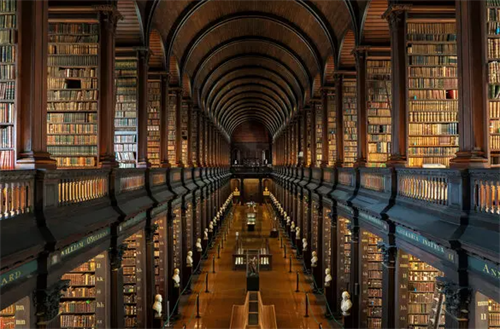
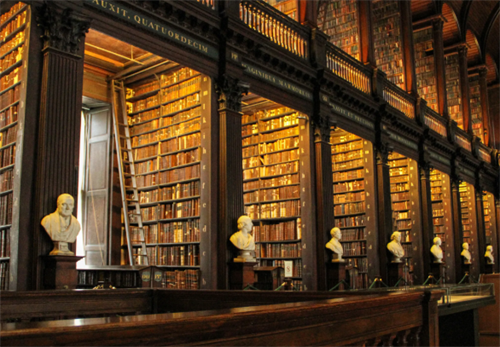
If there is one place where children instinctively lower their voices, it is Trinity College Library’s Long Room. At nearly 65 meters long, lined with dark oak shelves and marble busts, it feels less like a building than a declaration: ideas matter here (Library of Trinity College Dublin, n.d.).
Parents often worry that historic libraries will bore children. In practice, the opposite happens. The Long Room works on a sensory level — the height, the smell of old books, the way sound echoes softly under the barrel-vaulted ceiling. It resembles the imagined libraries of fantasy fiction not because of magic, but because of scale and reverence.
Family Insight:
Rather than explaining everything, let children react first. Ask simple questions:
Why do you think people kept books like treasures?
If this room hid a secret passage, where would it be?
These questions anchor imagination in reality — the same mechanism that makes fantasy stories endure.
Marsh’s Library: Where Stories Feel Secret
If Trinity is grandeur, Marsh’s Library is intimacy. Founded in 1707, it remains largely unchanged, complete with original reading cages designed to prevent book theft. For children, it feels like stepping into a hidden chapter of history (Marsh’s Library, n.d.).
This is one of Dublin’s most powerful literary spaces precisely because it is small. The rooms feel enclosed, almost conspiratorial. You sense the presence of past readers — scholars, rebels, and curious minds who once sat where you sit.
Why It Works for Families:
Short visit time (ideal for younger children)
Strong “secret library” atmosphere
Affordable entry, with free access for under-18s
Parents often tell me Marsh’s is where their children first understand that books were once dangerous, protected, and powerful. That realization is more effective than any lecture on history.
Literary Museums That Bring Stories to Life:
Dublin’s literary museums succeed because they avoid hero worship and instead focus on process.
At the Museum of Literature Ireland (MoLI), children encounter drafts, letters, and artifacts that show writers as working people — revising, failing, trying again. Seeing the first printed copy of Ulysses does not intimidate; it demystifies. Literature becomes something made, not bestowed.
The James Joyce Centre further grounds this idea, connecting everyday Dublin addresses to scenes in Ulysses. Even families unfamiliar with Joyce find value here, because the exhibits demonstrate how ordinary streets become extraordinary through attention.
Parent Tip:
Museums are ideal places to introduce the idea that stories grow out of places. This reinforces reading comprehension in children and encourages them to notice their own environments differently.
Bookshops: Letting Children Choose Their Own Stories
Dublin’s independent bookshops are not curated for tourists — they are working cultural spaces. Hodges Figgis, founded in 1768, remains a pilgrimage site for readers because it invites lingering. Children browsing here quickly realize that books are not assignments; they are possibilities.
Smaller shops like Ulysses Rare Books, Stokes Books, and The Winding Stair introduce the thrill of discovery — uneven stacks, unexpected finds, and second-hand treasures. For families, this is an opportunity to let each child select a book connected to the journey.
Travel Tradition to Try:Buy one Dublin-related book per child and read it during the trip. This anchors memory to narrative — a technique proven to enhance recall and emotional connection in young readers.
Cafés Where Stories Have Always Been Told:
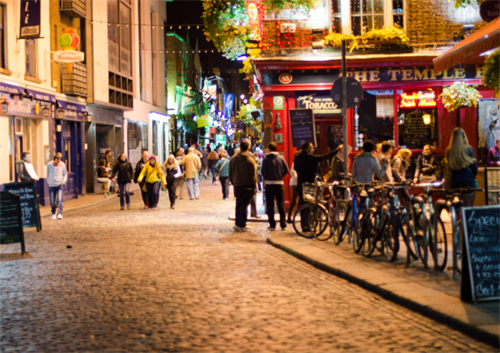
Dublin’s café culture matters because it mirrors how stories are shared — through conversation. The city’s cafés function as informal salons, welcoming writers, students, families, and thinkers alike.
Bewley’s Café on Grafton Street remains the most iconic. Its stained glass, long tables, and literary clientele (including Joyce, Beckett, and Kavanagh) make it ideal for unhurried afternoons. Children notice something subtle here: adults reading without screens, talking without hurry.
Nearby, smaller cafés near Trinity and along the Liffey provide quieter alternatives. What matters is not pedigree but permission to linger. Encourage children to sketch, write, or read while you talk — you are modeling a life where ideas matter.
Literary Pubs: Understanding the Oral Roots of Storytelling
For families with older teens, Dublin’s literary pubs offer cultural context rather than consumption. Pubs like Davy Byrne’s, Neary’s, McDaid’s, and Toner’s appear repeatedly in Irish literature because they are spaces of debate.
The Dublin Literary Pub Crawl, led by actors rather than guides, succeeds because it frames literature as spoken art. Quotes are delivered aloud, humor is emphasized, and history feels communal rather than academic.
This helps teens understand that before stories were printed, they were performed. Fantasy, folklore, and modern novels all trace back to this oral tradition.
The Abbey Theatre: Stories on Stage, Nation in Formation
Founded in 1904 by W.B. Yeats and Lady Gregory, the Abbey Theatre is more than a playhouse — it is a cultural engine. Its productions shaped modern Irish identity, often provoking controversy alongside applause.
For families, the Abbey offers two things:
Affordable access to world-class theatre;
A chance to show children that stories influence society;
Backstage tours reveal how scripts move from page to performance — reinforcing the idea that literature is alive, collaborative, and relevant.
The Grand Canal: Reading Without Walls
The Grand Canal is Dublin’s quiet literary counterpoint. Patrick Kavanagh loved it for its stillness, writing of its “leafy-with-love banks” as a form of redemption.
This is where families should slow down. Sit by the water. Read aloud. Watch ducks drift past. Travel research consistently shows that unstructured time enhances learning retention — and the canal provides exactly that.
Children often remember this stop more vividly than museums, because it associates literature with calm rather than obligation.
Literary Festivals: When the City Speaks Back
Dublin’s literary life is not frozen in the past. Festivals like the International Literature Festival Dublin, Dublin Book Festival, and Dalkey Book Festival bring contemporary writers into conversation with readers.
For families, these events normalize authorship. Children see writers answering questions, laughing, and discussing doubt — reinforcing that storytelling is an accessible human craft.
The Practical Magic: Planning Your Story
-Where to Stay:
For Central Luxury: The Merrion Hotel offers elegance and stunning gardens, with family suites and an impeccable location.
For Modern Comfort & Space: The Marker Hotel in the Docklands provides sleek rooms and a fantastic rooftop bar for parents, while apartments at Staycity Aparthotels (multiple locations) give you kitchen facilities and separate living space.
-Where to Eat (Without Fuss):
Queen of Tarts (Temple Bar/Castle Street): A storybook café with towering cakes, hearty quiches, and hot chocolate that delights all ages.
The Woolen Mills: Overlooking the Ha’penny Bridge, this bustling spot has a “proper” Irish menu and a relaxed vibe where noise is welcome.
Picnic Perfection: Grab artisan bread, local cheese, and treats from Fallon & Byrne in Rathmines or a Sheridans Cheesemongers stall, and head to St. Stephen’s Green.
-Your 4-Day Storyline: A Sample Itinerary
Day 1: The Literary Immersion. Morning at Trinity Library. Lunch at a Grafton Street café. Afternoon at MoLI or a stroll through the creative quarter.
Day 2: History & Parks. Morning at Dublin Castle. Picnic in St. Stephen’s Green. Afternoon exploring Phoenix Park and Dublin Zoo.
Day 3: Choices & Charm. Option A (Literary): Marsh’s Library, then a browse in Hodges Figgis bookstore. Option B (Coastal): Take the DART train to the charming village of Howth for a cliff walk and fish & chips.
Day 4: Personal Passion. Fill this with your family’s favorite discovery—a return to a beloved spot, a river cruise, or exploring the science galleries at the National Museum.
-Smart Savings Tips:
The Dublin Pass can offer significant savings if you plan to visit several paid attractions in quick succession.
Many museums, including all national museums, offer free admission.
Use the LEAP Visitor Card for unlimited bus, tram (Luas), and train (DART) travel within the city.
Dublin does not overwhelm families with spectacle. Instead, it offers something subtler and more enduring: a shared intellectual atmosphere. Children leave not just remembering places, but feeling that books belong to everyday life.This is why Dublin pairs so beautifully with the spirit of Harry Potter. Not because of spells or castles, but because it teaches the same lesson Rowling’s stories do — that knowledge is powerful, imagination is moral, and stories help us grow.Long after your family leaves Ireland, you may find that Dublin has quietly changed how your children read, listen, and think. And that, in travel, is the rarest magic of all.
References:
[1]Library of Trinity College Dublin. (n.d.). History of the library. Trinity College Dublin. https://www.tcd.ie/library/about/history.php
[2]Marsh’s Library. (n.d.). Visitor information and collections. https://marshlibrary.ie
[3]Museum of Literature Ireland. (n.d.). Exhibitions and collections. https://moli.ie
[4]Tourism Ireland. (2023). Dublin city’s literary attractions. https://www.ireland.com
[5]Rowling, J. K. (n.d.). Biography and writing background. https://www.jkrowling.com
Recommended for you: